 Alt
AltNEMA adapter chart for EV charging
Every outlet you're likely to meet, what it actually delivers, and the one that disappoints everybody.
The number on the breaker is not the story. The voltage is.
A "30 amp" RV outlet is 120V and gives you less than half what a "50 amp" outlet does — not 60% of it. Amperage without voltage tells you nothing. Every disappointment in this table traces back to that one confusion.
The chart




Receptacle diagrams via Wikimedia Commons, recoloured for this site — credits.
Same information, as numbers
| Outlet | Volts | Breaker | Car set to | Power | Range/hr |
|---|---|---|---|---|---|
| 14-50R | 240 | 50A | 32A | 7.7 kW | 25–30 mi |
| 6-50R | 240 | 50A | 32A | 7.7 kW | 25–30 mi |
| 14-30R | 240 | 30A | 24A | 5.8 kW | 17–20 mi |
| L14-30R | 240 | 30A | 24A | 5.8 kW | 17–20 mi |
| 10-30R | 240 | 30A | 24A | 5.8 kW | 17–20 mi |
| TT-30R | 120 | 30A | 24A | 2.9 kW | 8–10 mi |
| 5-20R | 120 | 20A | 16A | 1.9 kW | 4–5 mi |
| 5-15R | 120 | 15A | 12A | 1.4 kW | 3–4 mi |
Range figures assume roughly 3.5 mi/kWh in mild weather. Cut them by a third below freezing. Why →
The three that need a warning
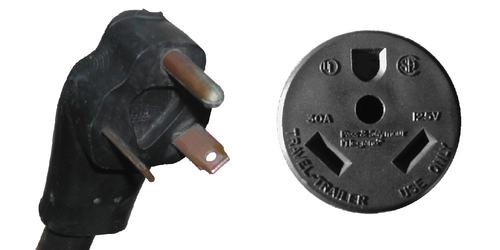
TT-30R — the RV 30 amp trap
This is the most misunderstood outlet in the country. "30 amp" sits between 20 and 50, so people assume it lands in the middle. It doesn't: TT-30 is 120V, so thirty amps buys about 2.9 kW — roughly a third of what a 50A pedestal gives you, not two thirds.
It's still the second-best thing at most campgrounds, and 8–10 miles an hour overnight is a real 80–100 miles. Just don't book a site expecting Level 2 speeds. Charging at RV parks →
10-30R — no ground
An older three-wire dryer outlet with no separate equipment ground; the frame is bonded to neutral. Adapters exist. Whether you should use one is a conversation with an electrician, not a blog post — an EVSE expects a real ground for its fault detection, and this outlet doesn't provide one.
6-50R — no neutral
Common in welding shops and garages. Two hots and a ground, no neutral, which is fine for EV charging because the car doesn't use the neutral anyway. A 14-50 adapter will not fit; you need a 6-50 specific one.
The rule that prevents most problems
Set the amperage in the car, not by choosing an adapter. The adapter tells the vehicle the outlet's ceiling; the car decides the rest. And never stack adapters — every junction is resistance, and resistance under a 6 kW continuous load is heat.
Which adapters and cords to buy → · Charge rate calculator →